
Quick answer: A proper air duct cleaning starts with an inspection and an estimate, then the crew protects your home, puts the HVAC system under negative pressure with a powerful vacuum, and uses brushes or air whips to knock debris loose from the ducts so the vacuum carries it out of your house. They also clean the registers, blower, and coil, and finish with a final inspection. For most homes the job takes a few hours. If dust or debris is still visible afterward, the system isn’t clean.
Most people have never watched an air duct cleaning, and that uncertainty is exactly what bad operators rely on. If you don’t know what a real job involves, you can’t tell whether you got one. This walkthrough covers what should happen, in order, from the estimate to the final inspection, based on NADCA’s written specification and how Clean Concepts approaches air duct cleaning in Montgomery and Central Alabama. If you’re still deciding whether you need a cleaning at all, start with is air duct cleaning worth it.
Before the Crew Arrives
The process starts with the estimate. Clean Concepts provides a free estimate before any work begins, and the price depends on the size of your system and how contaminated it is. That’s a good sign to look for in any company, because a fair price can’t be set without knowing what’s in your system.
Your preparation is simple. Clear access to your vents and registers by moving furniture, drapes, and anything else in the way. Plan to be available during the appointment window, and tell the technician about anything you’ve noticed, like weak airflow in one room or an odor when the system starts. That gives them a starting point for the inspection.
Step by Step: What a Proper Cleaning Looks Like
Step 1: The Inspection
Before anything is cleaned, the crew should look. Clean Concepts begins with a thorough inspection to identify mold, debris levels, and problem areas such as collapsed sections, disconnected runs, and signs of past water damage. Ducts that are crushed or disconnected can cause airflow and dust problems that cleaning alone won’t fix, and this is the moment to find out.
Step 2: Protecting Your Home and Setting Up Negative Pressure
This is the step that separates real cleanings from cosmetic ones. NADCA’s specification calls for the HVAC system to be kept at negative pressure relative to the rest of the house for the entire job, with HEPA-filtered negative air machines running continuously. In plain terms, the vacuum is pulling air through the system so loosened dust and debris travel toward the collection equipment instead of into your rooms. NADCA doesn’t endorse truck-mounted equipment over portable units, and both can clean to standard, but any vacuum that exhausts indoors must be HEPA filtered.
Step 3: Opening Access Points, If Needed
Sometimes a technician needs a small opening to reach a section of the system with tools and to see inside. NADCA’s specification says any new opening must be made without compromising the duct and later closed with a mechanically fastened panel (screws or rivets), with the location noted in the job records. If openings are needed in your home, ask where they were made and how they were closed.
Step 4: Agitation and Vacuum Collection in the Ducts
This is the heart of the job. NADCA describes it as source removal: brushes, air whips, or skipper balls agitate the surfaces inside the ducts to break debris loose, and the vacuum captures it right away. A vacuum alone isn’t enough, because dirt stuck to duct walls won’t be pulled off by airflow. Clean Concepts uses professional-grade equipment to pull debris from inside the ductwork, not just the visible vent openings. Both the supply and return sides of the system should be cleaned.
Step 5: Registers and Grilles, Cleaned by Hand
The vent covers get attention too. Clean Concepts hand-cleans every vent cover to catch debris missed earlier. It’s a small step, but it’s the one you can see, and it’s a good measure of whether the crew is being thorough.
Step 6: Blower, Coil, and Drain Pan
A duct cleaning that stops at the ducts is only part of a cleaning. NADCA says all key components should be cleaned: the ducts, coils, drains, registers, and grilles. For coils and blower assemblies, technicians visually inspect first to decide between dry cleaning with mechanical agitation and HEPA-filtered negative air, or, if biological growth is suspected, a controlled wet method with proper capture. Drain pans should be cleaned and flushed, with drainage checked before and after. Internal duct insulation is cleaned by mechanical agitation without tearing or damaging it, and never with water.
Step 7: Mold Treatment, Only If Needed
If mold is confirmed or suspected, Clean Concepts applies a mold treatment as part of the service. Treatment should never be a routine add-on. NADCA says antimicrobial products are appropriate only for a specific microbial problem, should be applied after the system has been thoroughly cleaned, and must be registered with the EPA for use in HVAC systems. Ask what product is being used and why.
Step 8: Final Inspection and Walkthrough
The last step is verification. The main test in NADCA’s specification is visual: the components must be visibly clean. The specification also defines a vacuum test for non-porous surfaces, where a filter cassette samples a marked area and the debris collected must weigh less than 0.75 milligrams per 100 square centimeters. A good technician will show you the result rather than just tell you. If you can still see dust or debris during the inspection, the system isn’t clean.
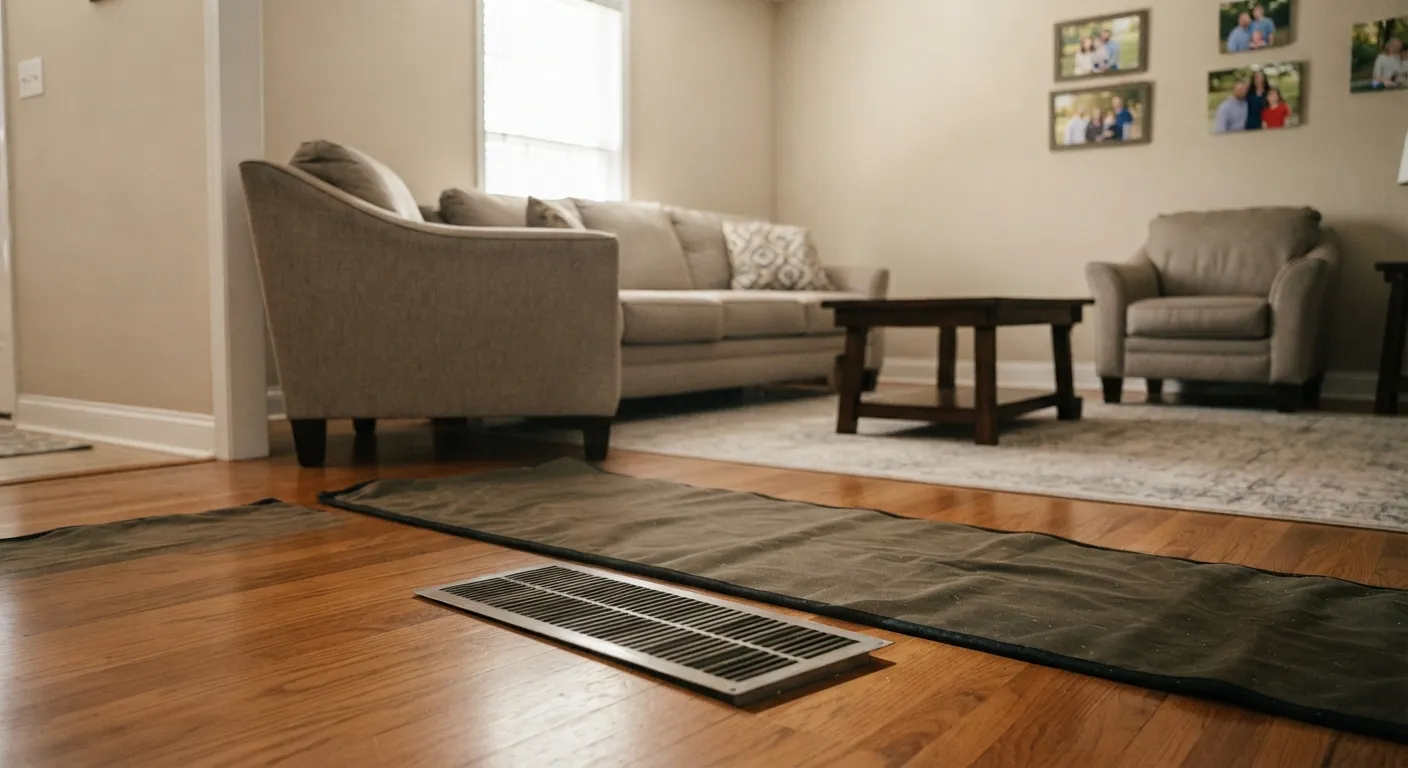
How Long Does It Take?
One manufacturer’s guidance puts most professional duct cleanings at three to five hours, with smaller homes toward the short end and larger or more complex ones running longer. Time depends on the size and layout of the system, how much debris has built up, how easy the components are to reach, and how many technicians are on site. Many homes in Central Alabama have ductwork in attics or crawl spaces, which can affect access. [Insert Clean Concepts typical job length for an average Montgomery-area home; not verified.]
A useful rule: if the crew is in and out far faster than the estimate suggested, ask what was left out.
Good Cleaning or Warning Sign?
| Part of the Job | What a Proper Cleaning Looks Like | Warning Sign |
|---|---|---|
| Estimate | Free, based on your system size and contamination | A flat “whole-house special” quoted before anyone looks at the system |
| Inspection | Ducts and components checked first, with problems pointed out | Work starts with no inspection |
| Method | Negative pressure, agitation tools, and vacuum collection | A vacuum hose held at the registers, with no agitation |
| Scope | Supply and return ducts, registers, blower, coil, and drain pan | Only the visible vent openings |
| Add-ons | Chemicals only for a specific problem, after cleaning, EPA-registered | Pressure to buy chemical treatments up front |
| Finish | Final inspection and a walkthrough | The crew leaves without showing you anything |
If you spot more than one warning sign, our guides to air duct cleaning scams and choosing a professional duct cleaning service explain what to do next.
What to Do After the Cleaning
Turn the system on and check that air is moving at every vent and that all covers are back in place. Ask about a fresh filter, since a clean system with a clogged filter won’t stay clean long. Keep any notes on where access openings were made. If you notice a musty smell when the AC runs, mention it to the company; that can point to a moisture issue that needs an HVAC technician.
Frequently Asked Questions
Do I need to be home during an air duct cleaning?
Plan to be available during the appointment window, at least at the start for the walkthrough and at the end for the final inspection. Confirm the details with your provider when you book.
Will air duct cleaning make a mess in my house?
It shouldn’t. Keeping the system under negative pressure with HEPA filtration is designed to keep dust out of your living space. If a company skips that step, expect more dust, not less.
Do they use chemicals during a cleaning?
A standard cleaning relies on agitation and vacuum, not chemicals. Antimicrobial treatments are optional and appropriate only for a specific problem, such as confirmed or suspected mold.
How can I tell the job was done right?
Look for a final inspection where you can see clean surfaces inside the ducts and components. NADCA’s standard is that the system must be visibly clean, and it offers a vacuum test for a numerical measure. Ask whether your contractor performs it.
Does duct cleaning include my dryer vent?
No, dryer vent cleaning is a separate service with its own equipment and schedule. Clean Concepts offers both, so ask about combining them in one visit. Learn more about our dryer vent services.
What’s the difference between truck-mounted and portable equipment?
Truck-mounted units are generally more powerful, while portable units can be brought closer to the ductwork. NADCA doesn’t endorse one over the other. What matters is that the job includes agitation and that the vacuum is HEPA filtered if it exhausts indoors.
Why Clean Concepts
Clean Concepts has served Montgomery and Central Alabama homeowners for more than 30 years [confirm founding-date phrasing: since 1989 / legally formed 2011]. We’re a NADCA member, which means a certified Air Systems Cleaning Specialist on staff and cleaning to ACR, the NADCA standard. Learn more about the benefits of hiring a NADCA member. We provide a free estimate before any work begins, and we stand behind our work with a 100% satisfaction guarantee.
Want to see what a proper cleaning looks like at your home? Call Clean Concepts at 334-425-0064 or visit our Montgomery duct cleaning page. We serve Montgomery, Prattville, Wetumpka, Auburn, Opelika, Alexander City, Selma, Troy, Greenville, Evergreen, and Centreville.