Why Dryer Vent Cleaning Is the Most Overlooked Fire Hazard in Montgomery Homes
There’s a fire hazard hiding in almost every home in Montgomery, AL — and most homeowners have no idea it’s there.
It’s not a faulty electrical panel. It’s not a gas leak. It’s not even a candle left burning too close to the curtains. It’s your dryer vent. And the lint, debris, and restricted airflow building up inside it right now could be setting the stage for a house fire that the National Fire Protection Association says happens more than 15,000 times every year across the United States.
In a city like Montgomery — where homes range from historic Craftsman bungalows in Cloverdale to newer subdivisions off Atlanta Highway and East Boulevard — dryer vent maintenance is rarely on anyone’s radar. People change their HVAC filters. They get their furnaces serviced. They watch for roof damage after storms. But the dryer vent, tucked behind the machine and disappearing into the wall, gets ignored for years. Sometimes for decades.
This article is about why that needs to change — and what Montgomery homeowners should know about one of the most preventable fire hazards in residential life.
The Numbers Are Serious
Before we get into the specifics of what makes dryer vents dangerous and why Montgomery homes are particularly vulnerable, it’s worth anchoring the conversation in facts.
According to the U.S. Fire Administration (USFA), a division of the Federal Emergency Management Agency (FEMA), clothes dryers are responsible for approximately 2,900 home fires per year in the United States, resulting in an estimated 5 deaths, 100 injuries, and $35 million in property damage annually.
The leading cause of those dryer fires? Failure to clean the dryer vent. Not mechanical failure. Not electrical faults. Not manufacturing defects. Failure to clean.
The USFA data consistently show that the peak months for dryer fires are January and February — the winter months when families do more laundry, run the dryer more frequently, and heating systems push warm air through homes that may already have restricted dryer vent airflow.
But in Montgomery, AL, where laundry runs year-round thanks to high humidity that makes clothing feel damp even indoors, the risk doesn’t take a summer vacation. The dryer runs. The lint builds. And without regular professional cleaning, the vent becomes a fire waiting for a spark.
What Actually Causes a Dryer Vent Fire?
Understanding the mechanics of a dryer vent fire makes the risk feel a lot more concrete — and a lot more urgent.
Your clothes dryer works by pulling in ambient air, heating it with either an electric element or a gas burner, tumbling that hot air through your clothes to evaporate moisture, and then exhausting the hot, humid air out through the vent duct to the exterior of your home. That exhaust carries with it the tiny fibers that shed off your clothing with every cycle — what we call lint.
Your dryer’s lint trap catches a significant portion of that lint. But it doesn’t catch all of it. A meaningful percentage of lint — especially the finest fibers — bypasses the trap and enters the vent duct. Over dozens and then hundreds of dryer cycles, that lint accumulates on the walls of the vent duct, around bends and elbows in the ductwork, and at the exterior vent cap where the duct exits the house.
As lint accumulates, airflow through the vent is restricted. Restricted airflow means the hot, moist exhaust air can’t escape efficiently. The dryer has to work harder and run longer to dry the same load of clothes. The internal temperature of the dryer and the vent duct climbs. Lint — which is essentially processed cotton fiber — is highly flammable. And when a highly flammable material is packed tightly around a heat source operating at elevated temperatures due to restricted airflow, the conditions for a fire are established.
All it takes is a temperature spike, an ember from the heating element, or a gas ignition event, and the lint inside the vent ignites. Because the vent duct runs through the wall cavity — often from the laundry room through interior walls to an exterior exit point — a vent fire can spread rapidly into the wall structure before there’s any visible sign of fire in the living space.
This is what makes dryer vent fires so dangerous. They often start inside the wall. By the time smoke detectors alert the household, the fire may already be well-established in the framing.
Why Montgomery Homes Face Elevated Risk
Dryer vent fires can happen anywhere, but certain conditions make some homes more vulnerable than others. Montgomery, AL, homeowners face several of those conditions in combination.
Longer Vent Runs in Older Montgomery Homes
Montgomery’s historic neighborhoods — Cloverdale, Garden District, Midtown, Capitol Heights, and the Old Cloverdale area near Huntingdon College — are full of beautiful older homes with laundry rooms that were added or converted well after the original construction. In many of these homes, the dryer sits on an interior wall that requires the vent duct to travel a long, winding path through the wall cavity or attic before exiting the house.
Every foot of duct length and every bend or elbow in the ductwork adds resistance to airflow. A dryer vent that travels 20 feet through two right-angle bends has significantly more resistance than a vent that exits the wall directly behind the dryer. More resistance means more lint accumulation at the bends. More lint accumulation means faster buildup and higher fire risk.
The NFPA recommends that dryer vent ducts not exceed 25 feet in total length, with length reductions for each elbow in the run. Many older Montgomery homes have installations that were never designed with this in mind.
Flexible Foil and Plastic Duct — Still Common in the River Region
Many Montgomery homes — particularly those built or renovated between the 1970s and the early 2000s — have dryer vents made from flexible foil accordion duct or, worse, flexible plastic duct. Both materials are problematic for multiple reasons.
Flexible foil and plastic ducts have ridged interior walls that catch and hold lint far more aggressively than smooth-walled rigid metal ducts. The accordion-style corrugations create dozens of small ledges where lint accumulates with every cycle. Additionally, these flexible materials can kink, crush, or sag over time — especially behind dryers that have been moved for cleaning or when items are stored against them — creating choke points that accelerate blockage.
Plastic flexible duct is actually prohibited by most building codes for dryer venting because it is combustible — it can melt or ignite if a dryer fire starts inside it. Foil flex duct is a step up but still far inferior to rigid metal duct for long-term safety and airflow efficiency.
If your Montgomery home has a flexible foil or plastic dryer vent duct, a professional cleaning is overdue — and a conversation about upgrading to rigid metal duct is worth having.
Alabama’s Humidity Means the Dryer Works Overtime
Montgomery’s climate is warm and humid for most of the year. Anyone who has done laundry in August and pulled clothes out of the washer, only to find they need another rinse cycle, knows what Central Alabama humidity does to laundry. That ambient moisture means dryers often need to run longer to fully dry a load — and longer cycles mean more heat exposure, more lint generation, and faster vent accumulation.
For families in the River Region, the dryer isn’t a seasonal appliance. It runs all year. Which means the lint accumulates all year. Which means annual professional cleaning isn’t a luxury — it’s a safety baseline.
Homes Near Autauga Creek and the Alabama River Bottomlands
Low-lying homes near water — particularly those near Autauga Creek, the Alabama River bottomlands, the wetlands around Lagoon Park, and the flood-adjacent neighborhoods in parts of west Montgomery — experience even higher ambient humidity levels than the rest of the city. In these homes, the moisture load on the dryer is consistently elevated, and the risk of lint combined with moisture creating a particularly stubborn blockage in the vent duct is higher.
Additionally, the exterior vent caps on homes in these areas are more susceptible to pest intrusion — birds, wasps, and small mammals will nest in an unguarded dryer vent cap, creating blockages that can be catastrophically dangerous.
Warning Signs Your Dryer Vent Needs Cleaning Now
Most homeowners wait until something goes wrong to think about their dryer vent. But the warning signs of a dangerous blockage are usually visible long before a fire occurs. If any of the following describe your dryer’s behavior, schedule a professional cleaning immediately.
1. Your clothes take more than one cycle to dry: This is the single most common and most reliable indicator of a restricted dryer vent. If a load of towels that used to dry in 45 minutes now takes 90 minutes or two full cycles, your vent is partially blocked. Your dryer is not failing — it cannot exhaust moisture efficiently because the vent is restricted.
2. The dryer feels unusually hot to the touch during or after a cycle: A dryer that is venting properly runs warm but not hot on the outside casing. If your dryer feels very hot to the touch — especially on the top or the door — it is retaining heat it should be exhausting. This is a direct fire risk indicator.
3. The laundry room itself feels hot and humid during a cycle: If heat and moisture are building up in the room around the dryer, some or all of the exhaust is not making it out of the house through the vent. It may be leaking into the wall cavity or the vent may be so blocked that air is backing up.
4. You notice a burning smell during a cycle: A burning smell — even a faint one — during a dryer cycle is a serious warning sign. Stop the dryer immediately. The smell may be lint beginning to scorch inside the vent duct. This is the immediate precursor to an active fire. Do not run the dryer again until the vent has been professionally inspected and cleaned.
5. The exterior vent flap doesn’t open when the dryer is running: Step outside and check the exterior vent cap while the dryer is running. The flap or louvers should open to allow exhaust to exit. If they don’t open or if you feel very little airflow coming out, the vent is blocked.
6. It’s been more than a year since your last cleaning: The NFPA recommends annual dryer vent cleaning for most households. If you can’t remember the last time your dryer vent was professionally cleaned, it’s overdue.
What Professional Dryer Vent Cleaning Actually Involves
The lint trap you clean after every load catches only a portion of the lint your dryer generates. The rest ends up in the vent duct — and no amount of do-it-yourself cleaning with a brush kit from the hardware store will address a serious accumulation the way professional equipment will.
A professional dryer vent cleaning from Clean Concepts Inc. involves:
1. Full duct inspection: Before cleaning begins, the technician inspects the entire vent run — from the dryer connection at the wall to the exterior vent cap. They identify the duct material, the total run length, the number and location of bends, and any visible signs of blockage, damage, or pest intrusion.
2. Disconnection and access: The dryer is carefully moved away from the wall and disconnected from the vent duct connection. This allows full access to the duct interior from both ends.
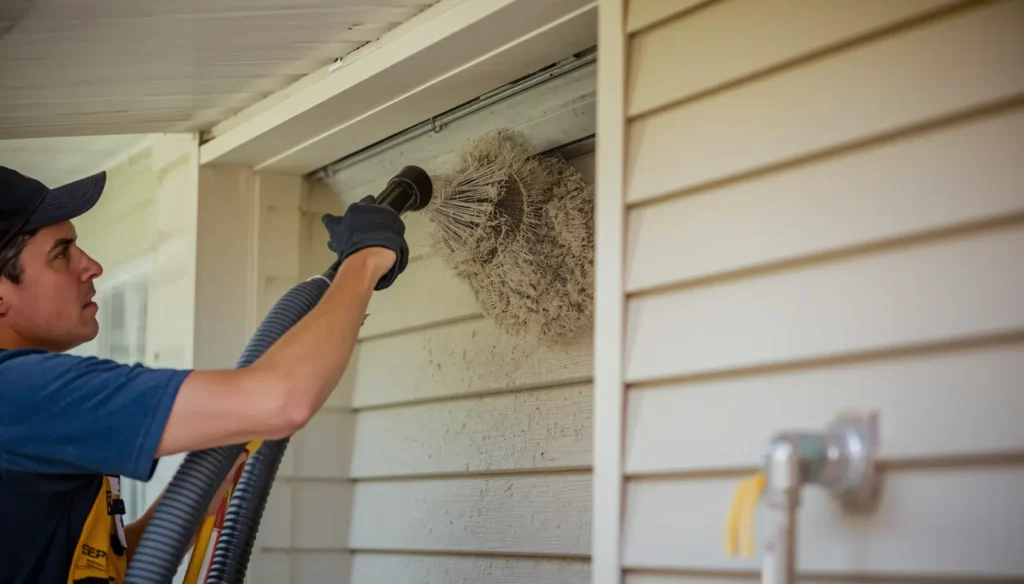
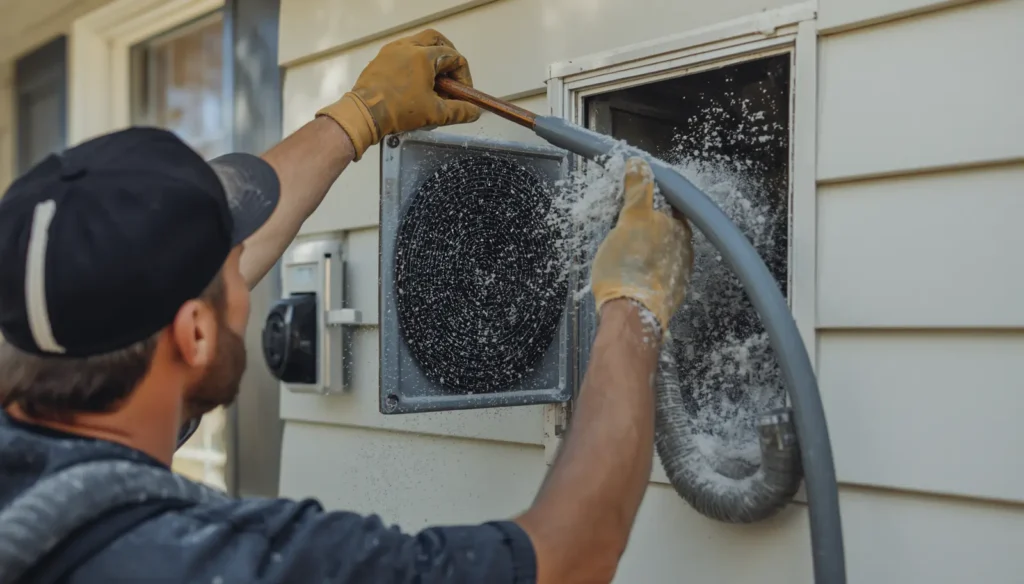
3. Professional-grade mechanical cleaning: Using flexible rotary brush systems and high-powered vacuum equipment, the technician works the entire length of the duct from both the interior access point and the exterior vent cap — dislodging accumulated lint from the duct walls, from around bends and elbows, and from the exterior cap assembly.
4. Exterior cap inspection and cleaning: The exterior vent cap is inspected for damage, blockage, and evidence of pests. Lint, debris, and any nesting material is removed. If the cap flap or louver is damaged or missing — allowing pests to enter — that is noted and can be addressed with a cap replacement.
5. Reconnection and airflow verification: After cleaning, the dryer is reconnected, run for a test cycle, and the airflow at the exterior cap is verified. You should feel strong, warm airflow at the cap when the dryer is running.
The entire process for a standard single-family home in Montgomery typically takes 45 to 90 minutes, depending on the duct length and condition. It is minimally disruptive, requires no major access beyond moving the dryer, and leaves your vent system clean, clear, and safe.
How Often Should Montgomery Homeowners Schedule Dryer Vent Cleaning?
For most households, annual cleaning is the right baseline. The NFPA and most fire safety authorities recommend yearly professional cleaning as the standard for residential dryer vents. However, certain households should clean more frequently — every six months in some cases:
1. Households that run the dryer daily or near-daily — large families, households with young children, caregivers doing frequent laundry.
2. Households with dogs or cats — pet hair accelerates lint accumulation significantly.
3. Homes with longer vent runs or multiple bends in the ductwork.
4. Homes with flexible foil or plastic duct rather than rigid metal.
5. Homes where the exterior vent cap has a history of pest intrusion.
If you’re unsure how long your vent run is or what material it’s made of, a professional inspection will answer those questions quickly and give you a cleaning schedule recommendation that fits your specific situation.
Beyond Fire Safety: The Other Reasons to Keep Your Dryer Vent Clean
The fire hazard gets the most attention — and rightly so — but it’s not the only reason to maintain a clean dryer vent.
1. Energy costs: A dryer struggling to exhaust through a partially blocked vent runs longer to dry the same load. That extra run time shows up directly on your Alabama Power bill every month. Annual dryer vent cleaning typically pays for itself in energy savings within a few billing cycles for households running the dryer frequently.
2. Appliance lifespan: A dryer that runs longer and hotter than it should wears out faster. The heating element, the motor, the drum bearings — all of these components have designed lifespans based on normal operating conditions. When the vent is blocked and the dryer is working overtime, those lifespans shrink. A dryer that should last 12 to 15 years may need replacement in 7 or 8 if it’s consistently running against a restricted vent.
3. Mold and moisture damage: A blocked dryer vent that forces moist exhaust air back into the laundry room — or into the wall cavity — can create moisture problems that lead to mold growth in the wall structure. In Montgomery’s humid climate, this is a genuine risk that can lead to costly remediation if left unaddressed.
4. Peace of mind: There is real value in knowing that the appliance running in your home is doing so safely. Annual dryer vent cleaning is a small investment relative to the risks it eliminates.
Don’t Wait for a Warning Sign — Schedule Before One Appears
The frustrating reality of dryer vent fires is that they often happen without dramatic warning. A vent that has been accumulating lint for years can reach a critical point quickly, and the transition from “working but slow” to “on fire inside the wall” can happen faster than most homeowners expect.
The best time to schedule a dryer vent cleaning in your Montgomery home is before you notice any of the warning signs described above. Annual maintenance cleaning — ideally at the same time each year so it doesn’t get forgotten — is the standard recommended by fire safety organizations. Set a reminder. Put it on the calendar. And then call a company you can trust to do the job right.
Why Montgomery Homeowners Trust Clean Concepts Inc. for Dryer Vent Cleaning
Clean Concepts Inc. has been cleaning dryer vents and air ducts in Montgomery and the River Region of Central Alabama since 1989. Owner Benjie Nall and his team have inspected and cleaned thousands of dryer vent systems in homes across the city — from the historic neighborhoods of Cloverdale and Old Cloverdale near Huntingdon College and Faulkner University, to the established subdivisions along the Zelda Road corridor, to the newer developments on the eastern side of Montgomery off Taylor Road and Vaughn Road.
As a certified NADCA member company, Clean Concepts brings the same commitment to professional standards to dryer vent cleaning that it applies to every air duct job. Every vent is inspected before cleaning. Every job uses professional equipment. Every price is quoted honestly, with no surprises at the end.
Dryer vent cleaning is not a side service at Clean Concepts — it’s a core part of what they do every single day. That focus and experience show in the results, and in the long list of Montgomery and River Region homeowners who have trusted the company with their homes for decades.
If your dryer vent hasn’t been professionally cleaned in the last year — or if you’ve never had it done — don’t wait for a slow cycle or a burning smell to prompt the call. Take the fire hazard out of your laundry room before it has a chance to become a crisis.
Conclusion: The Bottom Line
Don’t wait for a slow dryer cycle or a burning smell to take action. Dryer vent fires are preventable — but only if you stay ahead of the buildup. Schedule your professional dryer vent cleaning with Clean Concepts Inc. today and protect your home, your family, and your peace of mind.
Clean Concepts Inc. | 526 Oliver Road, Montgomery, AL 36117 | 📞 334-425-0064 Serving Montgomery, Prattville, Wetumpka, Millbrook, Selma, Auburn, Opelika, Troy, Greenville, Evergreen, Centreville, and surrounding areas throughout the River Region of Central Alabama. Monday – Friday | 7:30 AM – 4:00 PM Call today for your FREE estimate.