
Quick answer: For a typical Alabama home, the industry guideline most often cited is a professional duct cleaning every three to five years, with an inspection every couple of years in between. Clean sooner if you have shedding pets, a smoker, or anyone with allergies or asthma, after a remodel or water damage, or any time you see mold, pests, or dust blowing out of your vents. In Alabama’s humid climate, the real trigger isn’t the calendar. It’s moisture. Dry, clean ducts can wait. Damp or dirty ones can’t.
If you live in Montgomery, Prattville, Auburn, or anywhere else in the River Region, your air conditioner works harder and longer than most of the country’s. That raises a question we hear often: does all that heat and humidity mean you need your air ducts cleaned more often?
The honest answer is sometimes, but not for the reason most people assume. Humidity doesn’t dirty your ducts on its own. What matters is what humidity can lead to, and what else is going on in your house. This guide walks through what the industry recommends, where the EPA takes a more cautious view, and how to build a schedule that fits your home instead of relying on one number.
What Do the Experts Actually Recommend?
Two well-known sources give two different-sounding answers, and both are worth understanding.
The National Air Duct Cleaners Association (NADCA), the trade group behind the industry’s cleaning standard, is most often cited as recommending residential duct cleaning every three to five years. NADCA’s own homeowner FAQ is less rigid. It says frequency depends on your household, and it lists the situations that call for cleaning more often: smokers in the home, pets that shed heavily, water damage to the home or HVAC system, residents with allergies or asthma, home renovations, and the period before you move into a new home.
The U.S. Environmental Protection Agency is more cautious. It does not recommend cleaning ducts routinely, only as needed. The EPA says to consider cleaning if there is substantial visible mold growth inside the ducts, if they are infested with rodents or insects, or if they are clogged with enough dust and debris that particles are being released into your home through the vents. If nobody in the household has allergies or unexplained symptoms, and a visual inspection shows no heavy deposits or mold, the EPA says cleaning is probably unnecessary.
How do you reconcile the two? Think of the industry number as a maintenance rhythm and the EPA’s list as a set of red flags. A sensible approach uses both: look at your system on a regular schedule, and clean when either the calendar or the condition of the ducts says it’s time.
Why Alabama’s Climate Changes the Conversation
Montgomery has a humid subtropical climate. Summers are hot and muggy, with average July and August highs around 92°F and average dew points close to 70°F from June through August. Annual average relative humidity in Montgomery hovers around 70 percent, and late summer and early fall can bring the remnants of tropical storms. For your ductwork, that has three practical consequences.
- Your system runs a lot. Cooling season in the River Region runs from late spring well into early fall.
- Moisture is more likely to show up where it shouldn’t. Cold supply ducts running through a hot, humid attic or crawl space can sweat. The EPA lists condensation on uninsulated air conditioning ducts as a classic moisture problem. A clogged condensate line, a leaky duct connection, or a storm-driven roof leak can add to it.
- Duct liner and insulation are vulnerable. If insulation on the inside of your ducts gets wet or moldy, the EPA says it cannot be cleaned effectively and should be removed and replaced.
Here is the part that surprises people: none of this means you should automatically schedule a cleaning every year. Some sources suggest annual cleaning for humid climates, but we don’t think a blanket rule like that is well supported. What the EPA does stress is that controlling moisture is the most effective way to keep mold from growing in ducts. In Alabama, you get the best return by managing humidity, inspecting regularly, and cleaning when the evidence says it’s time.
A Practical Schedule for Central Alabama Homes
The ranges below combine the commonly cited industry guideline with the household factors NADCA lists. Treat them as starting points, not rules.
| Your Situation | Suggested Schedule | Why |
|---|---|---|
| Typical home, no pets or allergies, filters changed regularly | Have the system looked at about every two years; clean roughly every 3–5 years, or sooner if the inspection shows buildup | Matches the common industry guideline, and the EPA’s “as needed” test still applies |
| One or more shedding pets | Every 2–3 years | Hair and dander collect in return ducts and on the blower |
| Allergies or asthma in the household | Every 2–3 years, and talk with your doctor about other triggers | Cleaning can reduce what’s circulating, but ducts are only one possible source |
| Smoker in the home | Toward the shorter end of the range | NADCA lists smokers as a reason to clean more often; residue and odor cling to duct surfaces |
| Remodel or construction | After the work is finished | Drywall dust and debris get pulled into open returns |
| Buying or moving into a home | Inspect before you move in; clean if warranted | NADCA lists cleaning before occupancy; you don’t know the system’s history |
| Water damage, roof or plumbing leak, storm intrusion | Promptly, once the moisture source is fixed | Wet ducts and insulation are where mold gets started |
| Visible mold, pests, or dust blowing from vents | Right away | These are the EPA’s stated triggers |
Seven Signs Your Ducts Can’t Wait for the Calendar
- Dust or debris puffing out of your vents when the system kicks on.
- A musty or damp smell when the AC starts, especially after a stretch of wet weather.
- Visible mold-like growth on registers, grilles, or around the air handler. Only lab testing can confirm mold, so treat it as suspected.
- Signs of rodents or insects, such as droppings, nesting material, or chewed insulation.
- Dust that returns within a day or two of wiping. Leaky returns, a clogged filter, or other sources can cause this too, so a proper inspection matters.
- Weak or uneven airflow, such as rooms that never cool down.
- Moisture stains, drips, or condensation on ducts, vents, or near the air handler.
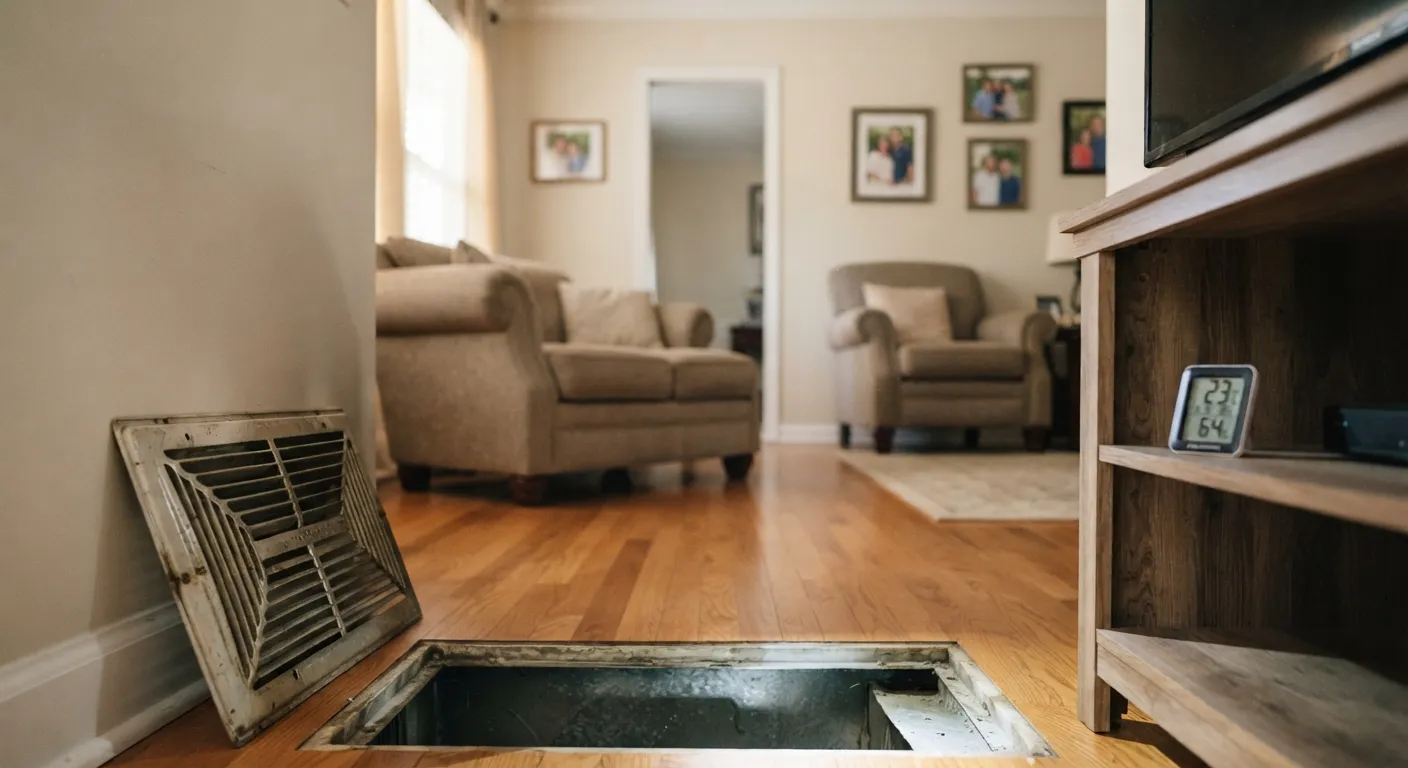
You can do a quick check yourself. Remove a supply register and shine a flashlight inside, using a small mirror if needed. If you see heavy deposits, growth, or anything that looks like nesting, stop there. The EPA advises against running the HVAC system if you know or suspect it is contaminated with mold, because it can spread through the house, so call a professional before you keep running it.
How to Keep Your Ducts Cleaner Between Cleanings
- Change your filter on schedule. Many homes need a fresh filter every one to three months, and homes with pets or heavy summer run time lean toward the short end. A clogged filter lets air find gaps around it and pull dirt straight into the system.
- Watch your indoor humidity. The EPA recommends keeping relative humidity below 60 percent, ideally between 30 and 50 percent. A simple humidity meter costs roughly $10 to $50 at a hardware store.
- Ask your HVAC technician to check the drain pan and condensate line before cooling season. Standing water and slow drains are common sources of moisture problems.
- Seal leaks. Loose duct connections in an attic or crawl space can pull hot, humid, dusty air into the system. An HVAC contractor can find and seal them.
- Don’t forget your dryer vent. It’s a separate system on a shorter clock. If it’s been more than a year since it was cleaned, or your towels need multiple cycles to dry, it’s overdue. Learn more about our dryer vent services.
If your home stays above 50 to 60 percent humidity even with the AC running, that’s worth investigating. Possible causes include oversized equipment that cools quickly and shuts off before removing much moisture, duct leaks, or a home that simply needs dehumidification. Fixing the cause will do more for your ducts than any cleaning schedule.
What a Proper Cleaning Looks Like
Whatever interval you choose, the cleaning has to be done right to count. NADCA describes the most effective method as source removal. The contractor places the system under negative pressure with a powerful vacuum while tools such as brushes and air whips dislodge debris, so the debris is carried out of your home instead of just moved around. A vacuum alone isn’t enough.
A trustworthy contractor will inspect the system before and after. NADCA’s guidance on judging the result is simple: if you can still see dust or debris during the inspection, the system isn’t clean. Antimicrobial chemicals are optional, are recommended only when there’s a specific microbial problem, and should be applied only after cleaning, using products registered with the EPA for use in HVAC systems.
Be skeptical of “$99 whole-house” specials and “blow-and-go” operators. NADCA warns about both. Our guide to avoiding duct cleaning scams covers what to watch for.
Frequently Asked Questions
How often should I clean my air ducts if I live in Alabama?
For most homes, the commonly cited guideline is every three to five years, with an inspection about every two years. Go sooner if you have shedding pets, smokers, allergies or asthma, a recent remodel, water damage, or signs of mold or pests.
Does Alabama’s humidity mean I need duct cleaning every year?
Not automatically. Humidity itself doesn’t make ducts dirty. It raises the risk of moisture problems like condensation and mold, which is why regular inspection and humidity control matter more than a fixed annual cleaning.
Can humidity cause mold in my air ducts?
It can, if moisture builds up inside the system. Mold needs moisture to grow, so condensation, a clogged drain pan, or a leak is usually the underlying cause. If you suspect mold, fix the moisture source and have the system inspected before continuing to run it.
Is there a best time of year to get my ducts cleaned?
The best time is when you have a reason, whether that’s a warning sign, a remodel, or a move. If you’re choosing freely, having the work done before cooling season means the system runs clean through the longest stretch of the year.
Do I need duct cleaning after a storm or water leak?
If water reached your ducts, air handler, or duct insulation, yes, have them inspected once the source of the moisture is fixed and the area is dry. Wet insulation inside ducts can’t be cleaned effectively and usually has to be replaced.
How often should I clean my dryer vent compared to my air ducts?
Your dryer vent is a separate system that needs attention more often. If it’s been more than a year since it was cleaned, or your dryer takes multiple cycles to dry a load, schedule it now.
Why Clean Concepts
Clean Concepts has served Montgomery and Central Alabama homeowners for more than 30 years [confirm founding-date phrasing: since 1989 / legally formed 2011]. We’re a NADCA member, which means a certified Air Systems Cleaning Specialist on staff, cleaning to ACR, the NADCA standard, and following the association’s code of ethics. Learn more about the benefits of choosing a NADCA member. We serve Montgomery, Prattville, Wetumpka, Auburn, Opelika, Alexander City, Selma, Troy, Greenville, Evergreen, and Centreville, and we stand behind our work with a 100% satisfaction guarantee.
Not sure whether your ducts are due? Call Clean Concepts at 334-425-0064 and we’ll help you decide on a schedule that fits your home, your family, and our Alabama humidity.